
8 days · Ishikawa · Fukui · Toyama · Niigata
Hokuriku Artisans & Design
This route is built around living craft districts rather than a checklist of famous landmarks. It links hand-forged blades in Takefu, washi in Echizen, Toyama glass and the metal towns of Tsubame-Sanjo, with gardens, sake breweries and one quiet shrine day at the end. It suits two travelers who like workshops, regional trains and time to look closely.
October is especially clear: days around 11–22°C, early sunsets near 17:15, and a compact umbrella for unpredictable Ura-Nippon weather.
Day 1
Kanazawa: Art and Traditional Crafts
10:00
21st Century Museum of Contemporary Art
Hours: 10:00–18:00; Friday and Saturday until 20:00; public zone 09:00–22:00; closed Monday
SANAA's low circular glass museum has no front or back: five perimeter doors let you enter from any side. Walk Galleries 1–6 and the inner courtyard for Leandro Erlich's swimming-pool installation, which splits the view above and below the waterline.
Sound pipes on the lawn carry your voice to a hidden pipe across the garden.
Book the Swimming Pool timed entry about a week ahead. Permanent collection around 1,200 JPY.
11:50
Kenroku-en Garden
Hours: 07:00–18:00 from 1 March to 15 October
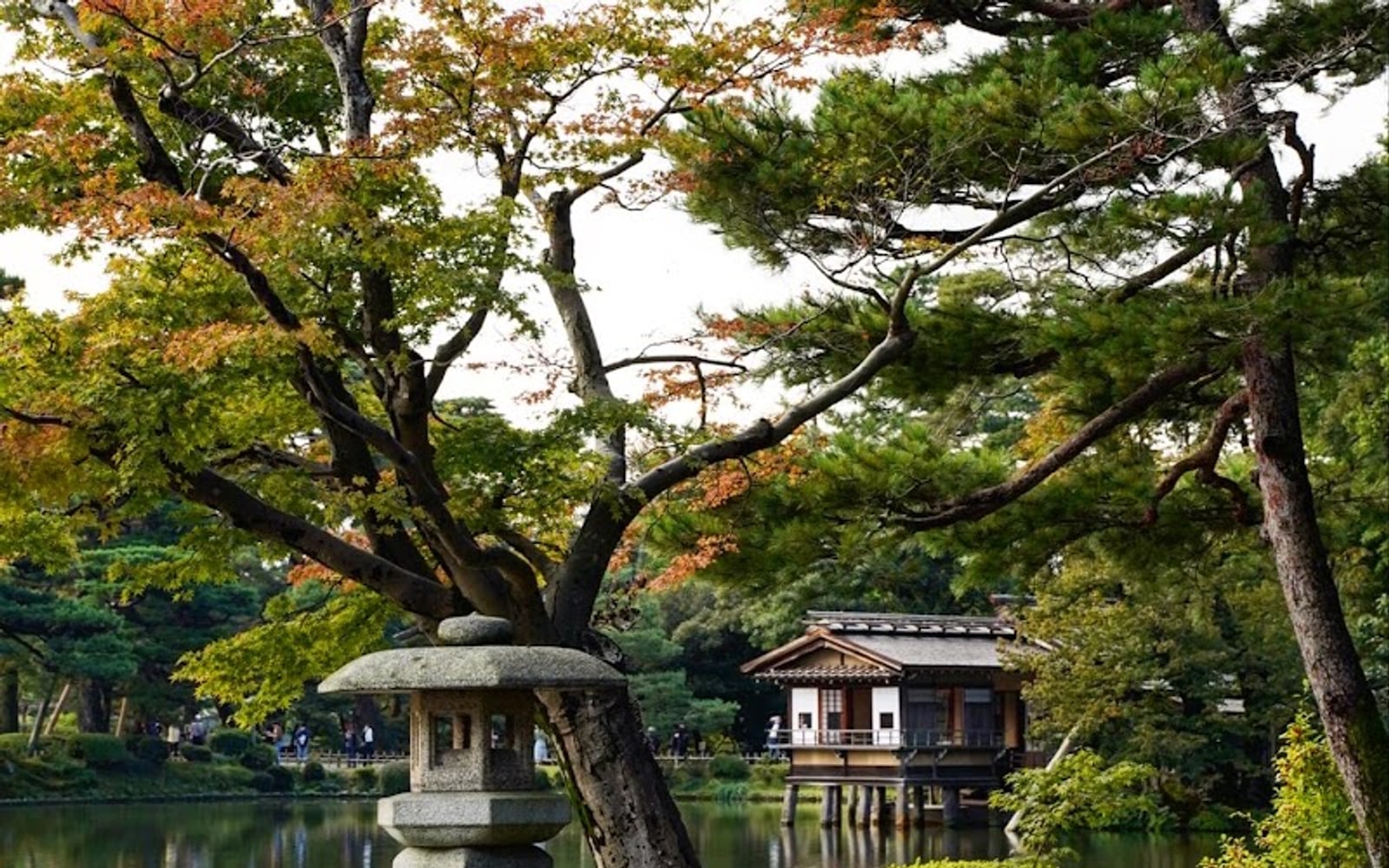
One of Japan's three great gardens, shaped by the Maeda lords over two centuries. Follow the streams to Kotoji-toro, the two-legged lantern above Kasumiga-ike Pond, and the pines still braced with yukitsuri ropes.
Japan's oldest working fountain sits mid-garden and runs on natural head pressure from Midori-taki, with no pump.
Admission 320 JPY. Look for the Karasaki Pine, grown from a seed a lord brought from Lake Biwa. The cafe at the Ishikawa Prefectural Museum of Art, a ten-minute walk from the contemporary museum, sells seasonal pastry by Hironobu Tsujiguchi.
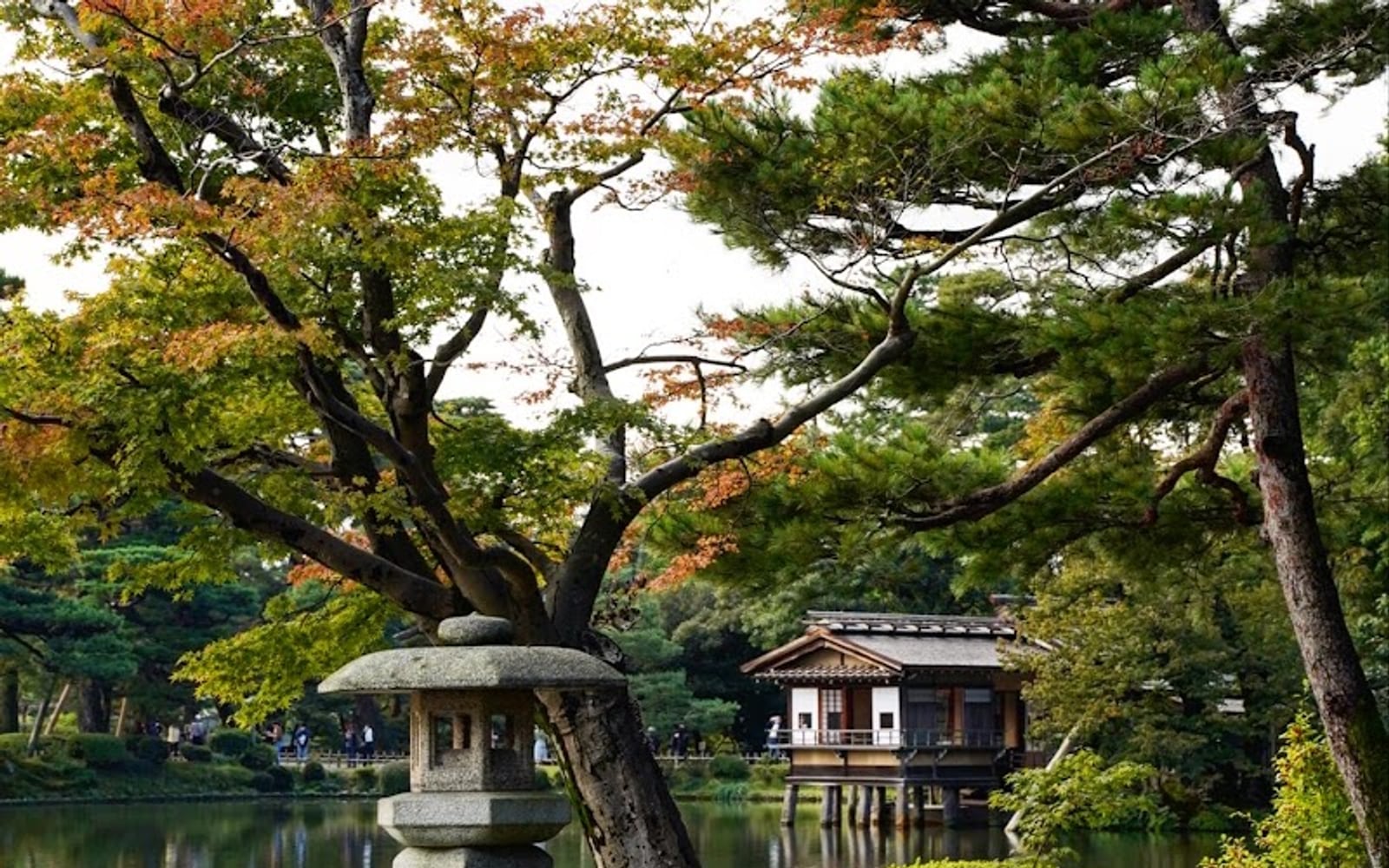
Photo: KKnn 15:10
Higashi Chaya District
Hours: District open at all hours; craft shops typically 10:00–17:00
Edo-era lattice teahouses line cobbled lanes across the Asano River. Kanazawa still makes most of Japan's gold leaf; shops here show how a gram is beaten into a sheet about two square meters and 1/10,000 of a millimeter thick. Shima Geisha House keeps performance rooms, silk costumes and instruments intact.
A tiny gold-leaf phone booth sits in the alley near Hakuichi.
Shima House is 500 JPY. Buy souvenirs before 17:00; the 16:30 light on the wooden facades is the best of the day.
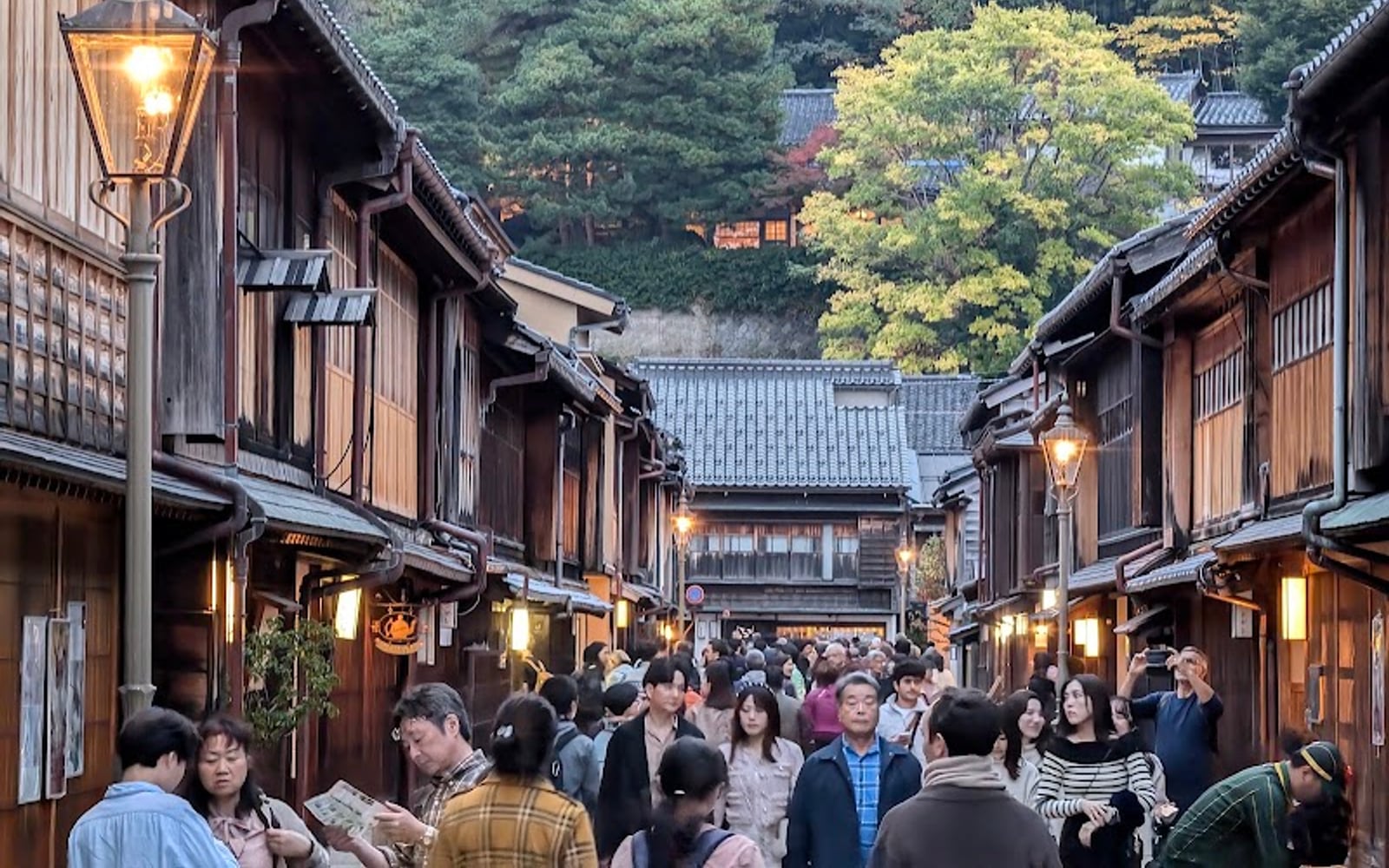
Photo: Thanos Metaxas 17:20
Fukumitsuya Sake Brewery
Hours: 10:00–19:00
Kanazawa's oldest working brewery has operated since 1625 and brews only junmai, with no added brewer's alcohol since 2001. Rain on Mount Haku is said to take more than a century to reach the well. Sit at the tasting counter for a flight of dry junmai daiginjo against aged bottles.
The boutique sells sake-lees ice cream and sweet fermented rice drinks.
Tasting flights around 1,000 JPY. The walk from Higashi Chaya takes about 15 minutes through residential lanes; watch for earthen kura storehouses.
Eat
Mori Mori Sushi (Horikawa-machi) — conveyor-belt Hokuriku seafood; try nodoguro · Fuwari (Owari-cho) — izakaya plates and local sake in a renovated warehouse near Higashi Chaya
Getting around
A short taxi links Kenroku-en to the Omicho area, then another to Higashi Chaya. Use the Kanazawa Loop Bus if you prefer not to taxi.
Look for
Hakuichi in Higashi Chaya for gold-leaf goods and gold-leaf ice cream · Nosaku near Kenroku-en for lacquerware
Budget note
About 15,620 JPY for two excluding lodging: attractions 2,020, dining 12,000, local transport 1,600.
Day 2
Kanazawa to Yamanaka Onsen: Samurai Culture and Nature
09:00
Omicho Market
Hours: Most stalls 09:00–17:00
Active since 1721, this covered market is still called Kanazawa's kitchen. More than 180 stalls sell sweet shrimp, uni, oysters opened on the spot and Kaga vegetables. The roof was built so winter trade could continue under heavy Sea of Japan snow.
Look for deep-fried Kanazawa curry buns filled with spiced pork.
Free to enter. Eat a kaisen-don upstairs or at a stall before leaving for Nagamachi.
11:00
Nomura Clan Samurai Home
Hours: 08:30–17:30
A restored residence of a high-ranking Maeda commander, with cedar sliding doors, painted screens and an armor room. The glass veranda looks onto a compact garden of waterfalls, moss and old bonsai that The Journal of Japanese Gardening has ranked among the best small gardens in the country.
Climb the narrow stairs to the second-floor teahouse for the lord's view of the garden.
Admission 550 JPY. The 20-minute walk from Omicho passes mud walls still fitted with straw koshimaki against winter rain.
13:25
Kanazawa to Yamanaka Onsen
Ride the Hokuriku Shinkansen to Kagaonsen (about 18 minutes), then the CANBUS or local bus into the Yamanaka valley. The station-to-onsen leg is about 30 minutes; keep coins or an IC card ready.
Total transfer is about 50 minutes after you leave Kanazawa Station.
14:40
Kakusenkei Gorge and Ayatori Bridge
Hours: Trail always open; seasonal kawadoko tea until about 16:30
A 1.3-kilometer riverside path follows the Daishoji through forest shade to the purple S-curve of Ayatori Bridge, designed by ikebana master Hiroshi Teshigahara. Stop at a kawadoko balcony for tea above the stone riverbed.
Stone monuments along the path mark Matsuo Basho's visit.
The trail is free; a tea set is about 600 JPY. A 15-minute walk along Yugaodo Street, lined with wood-carving workshops, leads to most ryokan.
16:25
Yamanaka Onsen ryokan
Hours: Check-in from 15:00
The mineral springs were recorded more than 1,300 years ago. Change into yukata, bathe in the outdoor stone baths and keep the evening free for kaiseki. Basho named Yamanaka among Japan's finest hot springs for the way the water left him feeling restored.
Wash thoroughly before the communal baths. Dinner is usually included; say if you need an earlier sitting after the gorge walk.
Eat
Omicho stall kaisen-don for a late breakfast or early lunch · Kaiseki at the ryokan — mountain vegetables and seasonal fish
Getting around
Have small change for the Kagaonsen bus if you are not using an IC card.
Look for
Yamanaka Shiki-no-Sato for Yamanaka lacquerware, known for wood-turning that shows the grain
Budget note
About 14,790 JPY excluding the ryokan: attractions 1,150, dining 12,000, transport 1,640.
Day 3
Yamanaka Onsen to Echizen: The Art of Washi
09:30
Transfer to Echizen
Bus back to Kagaonsen, then the Hokuriku Line south to Takefu. From the station, a 15-minute taxi reaches the papermaking valley of Goki-cho.
Allow about 1 hour 45 minutes door to door. Taxis are the practical way from Takefu into the washi village.
13:00
Echizen Washi Village (Papyrus House)
Hours: 09:00–16:00; closed Tuesday and New Year
The valley has made washi for about 1,500 years. In the Papyrus House workshop, mix kozo fibers and press a sheet with flowers or silk threads. Echizen paper was chosen in 1868 for Japan's first national notes, the Dajokansatsu, because it lasted.
The shop sells washi-woven ties and paper wallets that hold up to daily use.
Admission is free; a papermaking session is 600–1,000 JPY. Make paper first so it has time to dry.
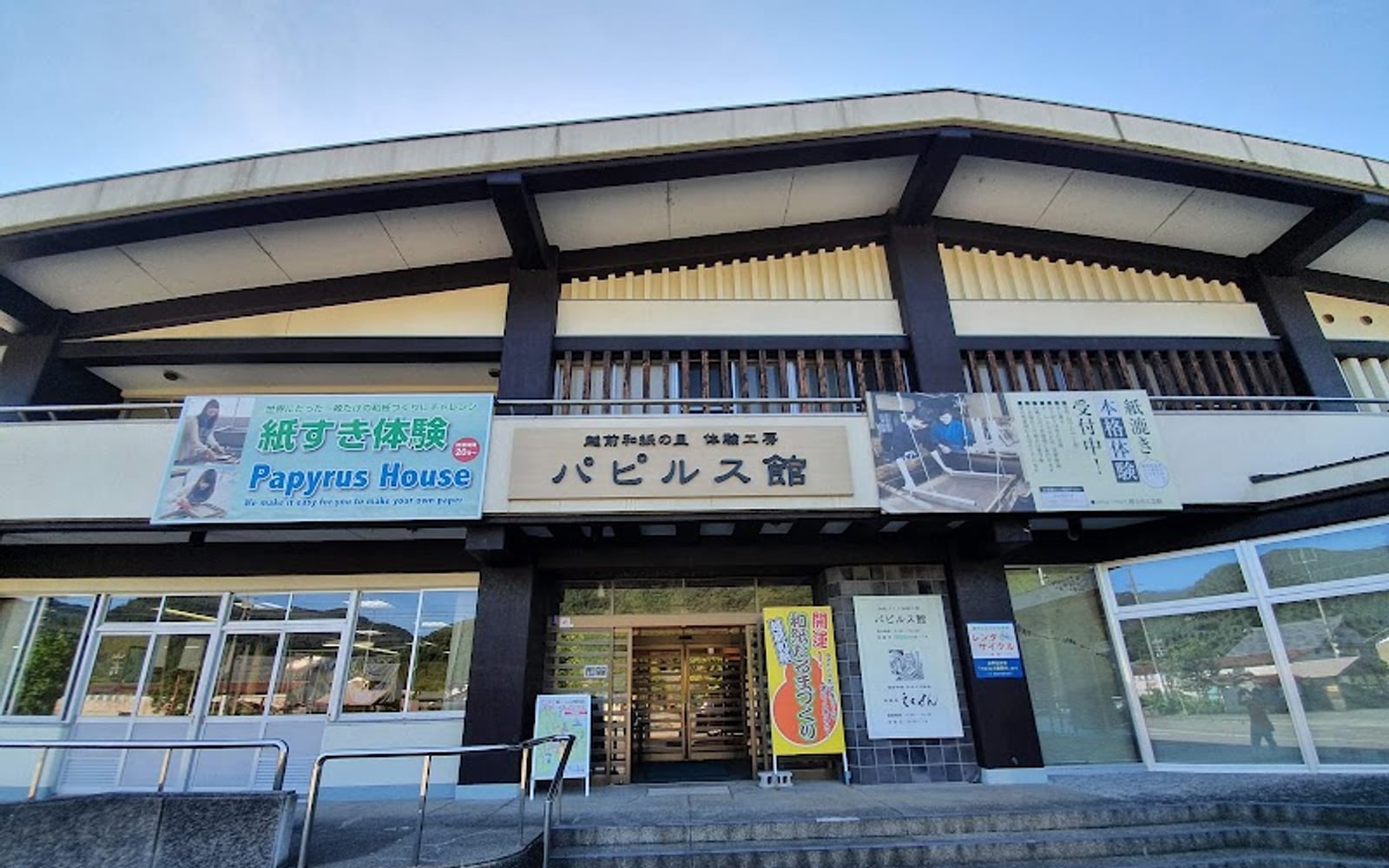
Photo: Michal Reiter 14:50
Udatsu Paper and Craft Museum
Hours: 09:30–17:00; last entry 16:30; closed Tuesday
A relocated Edo papermaker's house where artisans still use nagashi-zuki, dipping and swaying the screen in the vat. The drying room keeps cherry-wood boards. It is one of the few places in Japan where the full traditional process runs on historic wooden gear and gravity-fed water.
Ask to see how hibiscus-root neri keeps fibers suspended in the water.
300 JPY, including the Paper Culture Museum. On the five-minute walk, look for udatsu firebreak wing-walls on older roofs — they once signaled wealth.
Eat
Echizen Soba no Sato (Magari-cho) — oroshi soba with grated daikon; short taxi from the village · Yodogawa (Hinode-cho) — set meals near Takefu Station
Getting around
Takefu is small; pre-book or call a taxi for the return from Goki-cho.
Look for
Papyrus House shop for handmade paper, stationery and interior sheets
Budget note
About 14,600 JPY: attractions 1,600, dining 10,000, transport 3,000.
Day 4
Echizen to Fukui: Blades and Gardens
09:35
Takefu Knife Village
Hours: 09:00–17:00
Thirteen independent smiths share one forge building. From the second-floor catwalk you can watch steel heated to about 1,200°C under spring hammers. The gallery shows Damascus kitchen blades and carved handles. After the samurai class ended, Echizen swordsmiths turned 700-year-old katana methods into cutlery.
The sharp triangular roof is meant to echo blade edges and nearby peaks.
Admission and the factory-floor view are free. Knives must go in checked luggage on the flight home.
13:05
Echizen to Fukui
Taxi back to Takefu, then the Hapi-Line Fukui train north to JR Fukui (about 20 minutes). A five-minute taxi from the station reaches Yokokan.
14:05
Yokokan Garden
Hours: 09:00–19:00 from 1 March to 5 November; last entry 18:30
The former Matsudaira villa circles an iris pond on giant stone-slab bridges. In the sukiya pavilion, sliding doors open over the water so the rooms feel as if they float. The bathhouse floor once sloped into the lake so bathwater drained into the duck ponds.
Two-meter granite stepping stones were brought from Echizen quarries in the 17th century.
220 JPY, or 350 JPY combined with the history museum.
15:50
Fukui City History Museum
Hours: 09:00–19:00 from 1 March to 5 November; last entry 18:30
Dioramas run from castle-town markets to 1950s interiors. The Henshin Echizenya corner lets you look at Edo palanquins. Archives include scholar Sanai Hashimoto, a voice behind the Meiji Restoration. Toneri Gate ruins were found under the site during construction.
A five-minute walk from Yokokan across the Hoei neighborhood.
Eat
Europe-ken main store (Junka) — the original sauce katsudon, near the station and museum · Atarashiya (Chuo) — refined local seafood
Getting around
The garden-to-museum walk is short and the nicest part of the Fukui afternoon.
Look for
Takefu Knife Village shop for a knife bought from the maker · Happiring at Fukui Station for prefecture crafts and sake
Budget note
About 13,350 JPY: attractions 350, dining 10,000, transport 3,000.
Day 5
Fukui to Toyama: Glass Art and Canals
09:30
Fukui to Toyama
Hokuriku Shinkansen from Fukui to Toyama in about 45 minutes, then the city tram south to Nishicho for the glass museum (about 10 minutes).
11:00
Toyama Glass Art Museum
Hours: 09:30–18:00; Friday and Saturday until 20:00; closed first and third Wednesday
Kengo Kuma's TOYAMA Kirari wraps the museum and city library in cedar, glass and aluminum. A six-story diagonal atrium leads to the Glass Art Garden, with room-scale work by Dale Chihuly. After the war, Toyama rebuilt its medicine-vial glass trade into a glass-art city.
The atrium beams are local Toyama cedar.
Permanent collection 200 JPY; special exhibitions around 1,000 JPY.
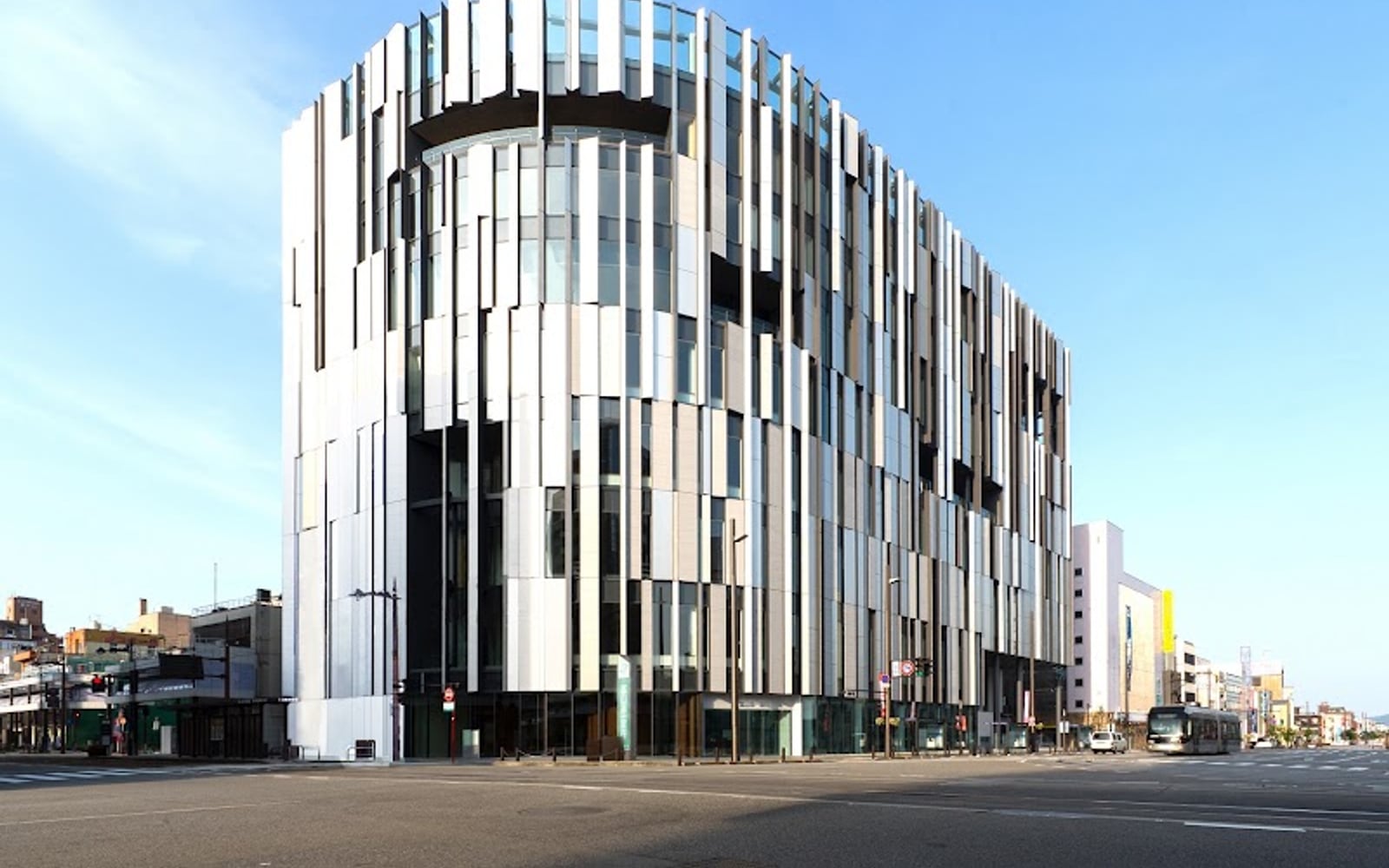
Photo: 富山市ガラス美術館 14:30
Fugan Canal Kansui Park
Hours: Park always open
A 9.7-hectare park along a former shipping canal. Cross Tenmon-kyo and take the elevator to the towers for Tateyama views when the air is clear. The glass-walled Starbucks here won an internal company contest as the world's most beautiful branch.
Tin cups on the bridge towers work as a red-string acoustic phone.
Free. A 15-minute walk from Toyama Station's north exit. Use an IC card on the tram.
16:25
Toyama Prefectural Museum of Art and Design
Hours: 09:30–18:00; rooftop 08:00–22:00; closed Wednesday
Galleries mix Picasso, Chagall and surrealist works with twentieth-century designer chairs you are meant to sit in. Screens hold more than 13,000 posters. Taku Sato's Onomatopoeia rooftop garden names sculptures after sound words such as pikapika and guruguru.
Collection ticket 300 JPY. Five minutes along the canal from Kansui Park.
Eat
Shiroebi-tei (Toyama Station) — white-shrimp tempura bowl, the jewel of Toyama Bay · Sushi-no-Midori in the station area for Toyama-style sushi
Getting around
Toyama's tram is the easiest way across the center. Aim for Kansui Park views before late afternoon cloud.
Look for
TAD museum shop for design goods and local glass · Toyama Marche in the station for masuzushi, pressed trout in bamboo leaves
Budget note
About 13,320 JPY: attractions 1,300, dining 11,000, transport 1,020.
Day 6
Sake and Metalworking
09:00
Masuizumi Sake Brewery, Iwase
Hours: 09:00–17:00
The Portram light rail runs north to the old port in about 25 minutes. Masuizumi sits on a restored merchant street of Meiji storehouses. The Kura Bar pours sake aged in French oak, a method this brewery helped introduce to premium junmai.
A nearby glass studio and a Kit Kat shop sell sake-infused chocolate.
Entry is free; tasting flights 500–1,000 JPY.
12:40
Toyama to Tsubame-Sanjo
Hokuriku Shinkansen and a regional connection across the prefectural border. Keep tickets handy; the trip is about 1 hour 50 minutes.
15:55
Tsubame-Sanjo Regional Industries Promotion Center
Hours: 09:30–17:30
A hall of more than 10,000 metal goods: copper kettles, chef knives, titanium campware, precision nail clippers and tableware used at state banquets. Tsubame-Sanjo makes over 90 percent of Japan's metal cutlery.
A 2.5-meter spoon stands near the main entrance.
Free. A 10-minute walk from Tsubame-Sanjo Station through the metalworking quarter.
Eat
Sushi Ken (Meirincho, Toyama) — Toyama-wan sushi before the train · Tsubame Sanjo Bit (Sugoro, Sanjo) — meals served on local metalware
Getting around
Regional connections need a buffer. Bring a jacket for the afternoon walk to the promotion center.
Look for
Suwada nail clippers and titanium tumblers in the promotion center
Budget note
About 13,500 JPY: tastings 500, dining 11,000, transport 2,000.
Day 7
Shokunin Culture and Design
10:00
Gyokusendo
Hours: 08:30–17:30; guided tours at 10:00, 11:00, 13:00, 14:00 and 15:10; closed Sunday and holidays
A wooden workshop open since 1816, where tsuiki artisans hammer copper sheets over anvils into seamless kettles. A single pot can take about 100,000 hammer blows. Natural oxidation colors the metal; the same recipe darkens the front doors.
Admission and tours are free. A 15-minute taxi from central Tsubame.
12:55
Tojiro Knife Factory
Hours: 10:00–17:00; closed Sunday and Monday
An open factory with glass galleries over press lines and hand-sharpening benches. The atelier hones 63-layer Damascus blades. Tojiro's cladding pairs a high-carbon core with stainless skins, a process used by many restaurant kitchens.
In the shop, compare handle weights to feel how balance changes control.
Free. About 10 minutes by taxi from Gyokusendo. Engraving is often available.
15:15
Snow Peak Headquarters
Hours: 09:00–19:00
A 50-acre campus in the Sanjo foothills, with a Kengo Kuma cedar building opening onto lawns where staff pitch prototype tents. Titanium campware, canvas tents and the Jyu-bako wooden tiny homes sit on the grounds.
The Jyu-bako mobile homes were designed with Kengo Kuma.
Free. The taxi from Tojiro is about 30 minutes; ask the driver to wait or book a return. Warm facade light is around 16:00.

Photo: nob kato
Eat
Tsubame Ramen Koushu (Isumi, Sanjo) — thick noodles with a seabura back-fat layer · Kansichi (Minami-kaneko) — seasonal Niigata vegetables and sake
Getting around
Taxis are the only efficient way between these three sites. Confirm factory days before you travel.
Look for
Tojiro gallery knives, with engraving if offered · Snow Peak HQ titanium Sierra cups sold only here
Budget note
About 18,000 JPY: dining 10,000, taxis around 8,000, no admission fees.
Day 8
Yahiko: Spiritual Roots and Departure
09:00
Train to Yahiko
The Yahiko Line crosses Echigo rice plains to Yahiko Station in about 30 minutes.
09:45
Yahiko Shrine
Hours: Grounds always open; treasury 09:00–16:00
The ichinomiya of old Echigo, with more than 2,400 years of recorded history, stands under 400-year-old cedars. Cross the vermilion Yahatabashi and bow at the haiden. The shrine has watched Niigata's rice harvest for centuries.
Try lifting the Hi-no-Tama Ishi; legend says a wish comes true if it feels light.
Grounds are free; treasury 300 JPY.
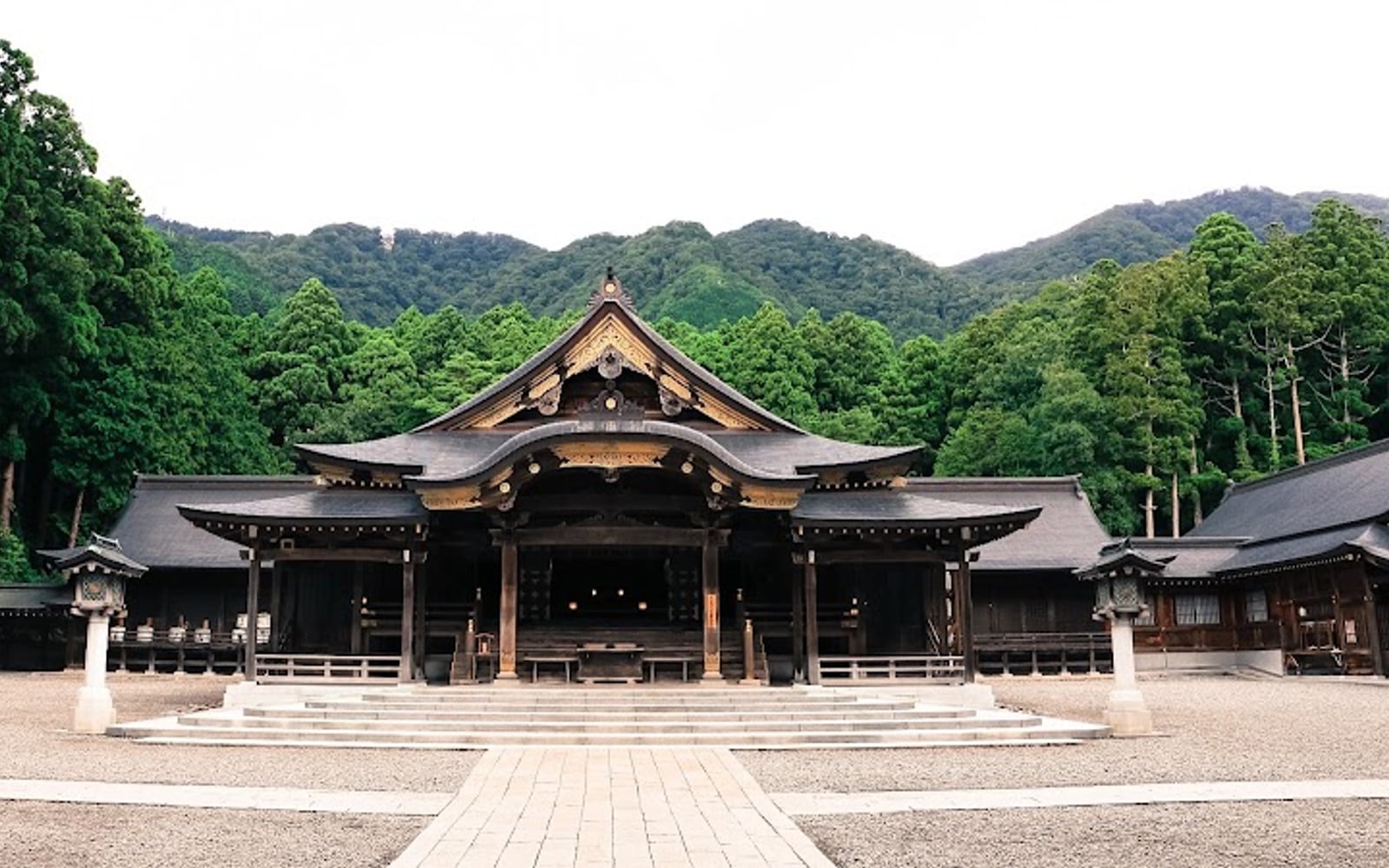
Photo: 越後国一之宮 彌彦神社 12:00
Mt. Yahiko Ropeway
Hours: 08:45–17:00
A five-minute ride climbs to 634 meters — the same height as Tokyo Skytree. The deck looks over the Sea of Japan, Sado Island and the rice plain. The Manyo garden at the summit grows plants named in early Japanese poetry.
The Okumiya sanctuary at the summit is dedicated to the shrine's deity couple.
Round trip 1,500 JPY. The summit is windier than the village; keep a windbreaker out. A 15-minute walk through Yahiko Park reaches the base station.
15:15
Joetsu Shinkansen toward Tokyo
Return on the Yahiko Line to Tsubame-Sanjo for luggage, then a Toki service to Tokyo Station in about 1 hour 50 minutes.
Be on the Tsubame-Sanjo platform at least 20 minutes before departure.
Eat
Omotenashi Hiroba (Yahiko) — panda-yaki cakes filled with edamame paste · Mikazuki at Tsubame-Sanjo Station — Italian, a local yakisoba with meat sauce
Getting around
Leave a buffer after the ropeway for the local train back.
Look for
Yahiko gate shops for tamagome sacred rice and travel charms
Budget note
About 13,800 JPY: attractions 1,800, dining 10,000, local transport 2,000, plus the long-distance shinkansen you already hold.
Where to stay
Kanazawa
KUMU Kanazawa
Design hotel in a renovated office; a good base for the museum and garden days. Rooms from about 15,000 JPY.
Kanazawa
Hotel Wing International Premium
Craft-inspired rooms near the station, useful for the morning departure to Kaga. From about 12,000 JPY.
Kaga
Yamanaka Onsen Kajikaso
Ryokan with hot springs a short walk from Kakusenkei. Dinner-inclusive rooms from about 22,000 JPY.
Echizen
Super Hotel Echizen Takefu
Practical business hotel with a natural onsen and breakfast, close to the washi and knife days. From about 10,000 JPY.
Toyama
Toyama Manten Hotel
City spa hotel; the top-floor bath has mountain views. From about 11,000 JPY.
Sanjo
Comfort Hotel Tsubame-Sanjo
Next to the shinkansen and factory taxi runs. From about 9,000 JPY.
Sanjo
Snow Peak Field Suite Spa
Kengo Kuma campus stay if you want one premium night. From about 60,000 JPY.